Miami-Dade painting permits and rules
Commercial painting rules in Miami-Dade County
In Miami-Dade, the paint itself rarely needs a building permit. The color often needs approval, the roof coating may need a permit, and the site rules on lead, height, wash water and airport access apply either way. This page sets out what we found, as of October 2026. It is general information, not legal advice.
Who May Paint a Commercial Building
Under Florida's s. 489.117, no city or county may make a painter, pressure washer, plasterer or stucco applicant hold a state or local license before pulling a permit for that work. There is a single carve-out. A city or county that already licensed roof-level painting, coating and cleaning on buildings taller than three stories before January 1, 2021, may keep that license.
Section 163.211 adds that local occupational licensing imposed before January 1, 2021 expired on July 1, 2025. Romco checks with the city whether anything is still asked of a contractor for rooftop work above three stories.
Romco Builders is a licensed Florida general contractor headquartered in Fort Lauderdale. Romco manages the painting job and coordinates separately licensed work, such as roofing, electrical or structural repair, with firms that hold those licenses.
Building Permits Versus Color Approvals
Miami-Dade County issues permits only for unincorporated areas, where folio numbers begin with "30". Each of the county's 35 municipalities has its own building official. The first step on any job is reading the folio, because it decides whose rules apply.
In unincorporated Miami-Dade, the Regulatory and Economic Resources department lists interior and exterior painting and roof painting as work not regulated by the Florida Building Code, so no building permit is needed. Waterproofing or watertight roof coatings do need one. A painted wall sign and the seal coating or re-striping of a parking lot each need a Zoning Improvement Permit. The county adds that an exemption does not allow work in violation of the code, and that its simplified process for small jobs is closed to properties in a flood hazard area.
Several cities have written color rules. Miami Beach requires a permit and city color approval for business exteriors. Coral Gables needs Board of Architects approval for all exterior paint. North Miami Beach requires a permit in commercial zones and a base color LRV of 35 or more. Miami Springs limits commercial buildings to three palette colors. Bal Harbour sends exterior paint to its Architectural Review Board first. The City of Miami needs a permit when paint work affects stucco, and a Certificate of Appropriateness in historic districts. Homestead ties grant work and its historic district to approved colors.
Lead Paint in Older Buildings
Under the EPA renovation rule, 40 CFR 745, a renovation is any modification that disturbs painted surfaces. The rule also reaches pre-1978 space where one young child, under 6, keeps coming back on two or more days of the same week. A daycare inside an older office or retail building can fall under it.
In that space, only an EPA-certified renovation firm may disturb the paint. Romco checks the building's age and use, and arranges a certified firm for the affected areas.
OSHA's lead standard, 29 CFR 1926.62, defines construction work as including painting and decorating, so it covers workers on any job that disturbs lead paint, whatever the building's use.
Work at Height: Scaffolds, Lifts and Rope Access
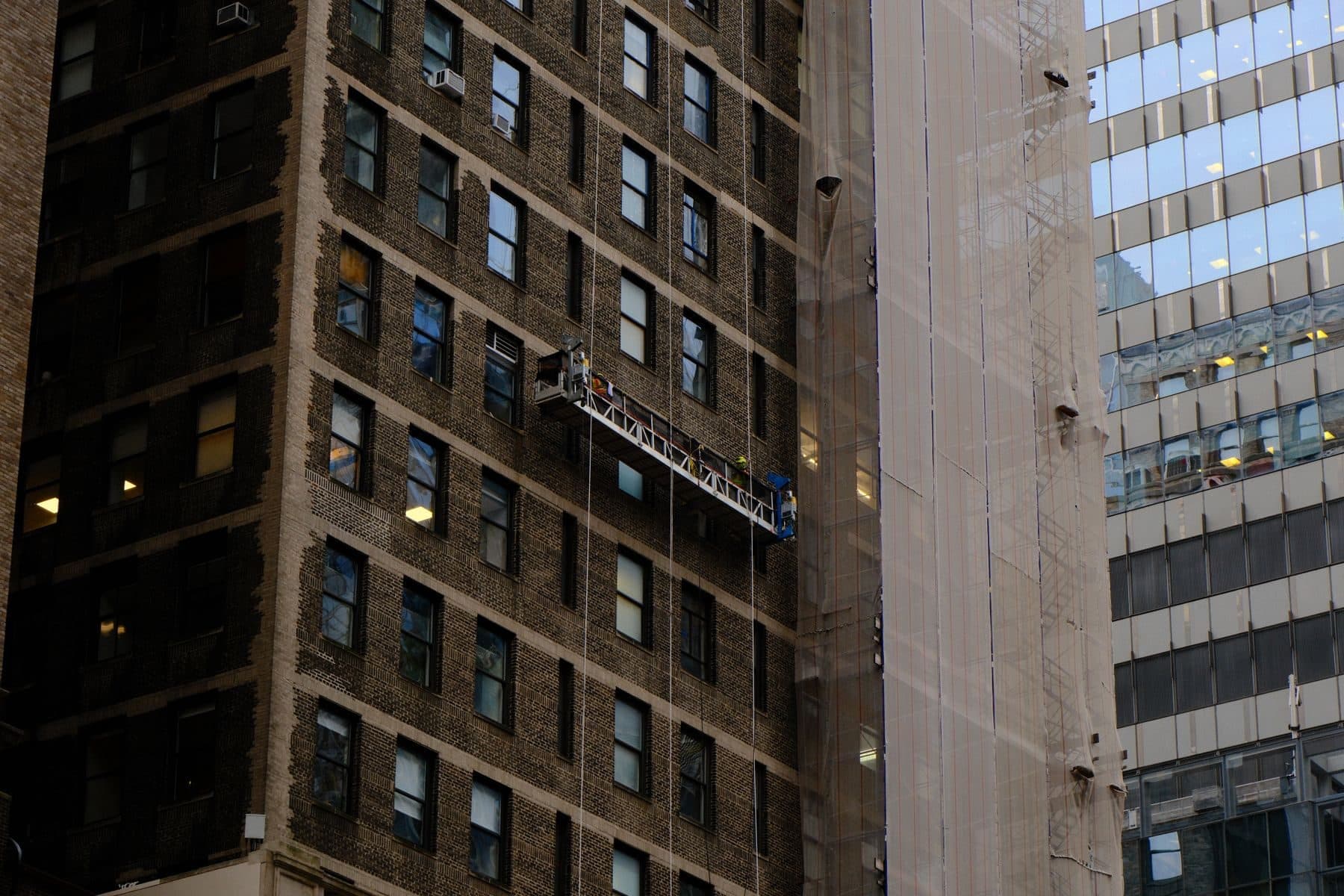
OSHA 29 CFR 1926.451 makes fall protection mandatory once a scaffold platform sits higher than 10 feet, and each scaffold must carry its own weight plus four times the heaviest load planned for it. Under 1926.453, anyone in an aerial lift basket is tied off to the boom or basket with a belt and lanyard.
For rope descent on a tower, 29 CFR 1910.27 puts the first step on the building owner. No one goes over the parapet until the owner has given the contractor written word that every roof anchor was found, load-tested to 5,000 pounds per worker in any direction, certified and kept up.
The same rule bars rope descent above 300 feet unless the employer shows other access is not feasible. Romco asks for the owner's anchorage letter at the quote stage, not on the day of mobilization.
Condominium Inspections and Reserve Studies
Florida's milestone inspection law, s. 553.899, sets the first inspection at 30 years, and a local enforcement agency may require it at 25. Miami-Dade's own recertification program, Section 8-11(f) of the county code, calls for an inspection at 30 years and every 10 years after that.
The county page also sets an earlier 25-year date for some coastal condominium and cooperative buildings of three or more stories, then every 10 years. It also says the building facade must now be included wholistically in the report. The county does not say the report requires repainting.
For condominiums, the structural integrity reserve study under s. 718.112 must include "waterproofing and exterior painting." Romco quotes painting and waterproofing to the scope those reports describe, after any structural repairs are complete.
High-Velocity Hurricane Zone Product Approval
Miami-Dade issues Notices of Acceptance (NOAs) for products used in the High-Velocity Hurricane Zone. The elastomeric coating NOAs we checked were all filed under Roofing, for roof coating systems. We found no NOA for wall paint or an elastomeric wall coating, so we do not claim one is required.
Romco checks product approval where a coating is part of a roofing or waterproofing system. The NOA text says misuse of an NOA as an endorsement terminates it, so we do not market a product by its NOA. Separately, architectural coatings sold in the United States must meet national VOC standards under 40 CFR 59 Subpart D.
Wash Water and Paint Waste
Section 24-42 of the Miami-Dade County code makes it unlawful to discharge into county waters any matter that causes water pollution or a nuisance. Our copy is the Florida DEP appendix, so we cite the rule, not the current section text.
The City of Hialeah states that its regulations and Miami-Dade County's prohibit non-stormwater discharges to any drainage system. Pressure-washing runoff and paint rinse water are not stormwater.
On a Miami-Dade job, Romco blocks storm inlets near the work, collects wash and rinse water, and arranges disposal away from the drains. We found no county guidance written for pressure-cleaning runoff, so we work to the general ban.
Airports and PortMiami
Airport security programs are set by federal rule, 49 CFR Part 1542. At Miami International Airport, the ID badge office in Terminal D, 3rd floor, serves airport employees and tenants, and applicants bring the approval notification to the CBT SIDA and Behavioral Detection training session. The Miami-Dade Aviation Department also lists five general aviation airports, including Miami Executive and Miami Homestead General Aviation.
PortMiami requires its own ID card application and a company authorization letter, plus a dockside application when dockside access is requested. A TWIC card is one of the accepted identity documents.
Romco quotes airport and seaport work. A job there runs on badging lead time, escorted access where badges are pending, after-hours shifts, and phasing that keeps gates, concourses and terminals in use.
Sources
Where these rules come from
- County list of work exempt from the building code
- County permit exemption request page
- County or city: who approves the work
- Miami-Dade building recertification program
- Sample HVHZ NOA for an elastomeric roof coating
- Second roof coating NOA reviewed
- Spray polyurethane roof system NOA
- County water pollution ban, DEP appendix copy
- Hialeah on storm drains and dumping
- MIA ID badge office information
- MDAD general aviation airports
- PortMiami ID: read before you apply
- Federal airport security rule, 49 CFR 1542
- Florida s. 489.117: painting license limits
- Florida s. 163.211: local licensing expiry
- Florida s. 553.899: milestone inspections
- Florida s. 718.112: condo reserve study items
- EPA renovation rule definitions, 40 CFR 745.83
- OSHA lead in construction, 1926.62
- OSHA scaffold rule, 1926.451
- OSHA aerial lift rule, 1926.453
- OSHA rope descent and anchorage rule, 1910.27
- Federal VOC limits for coatings
- Miami Beach business guide on paint permits
- Coral Gables development FAQ on exterior paint
- North Miami Beach paint color code report
- Miami Springs color palette application
- Bal Harbour building permits page
- City of Miami permit-exempt work
- Homestead commercial enhancement grant rules
Questions
Permit questions from Miami-Dade owners
Is a Miami-Dade commercial repaint a permit job?
In unincorporated Miami-Dade, painting needs no building permit, though watertight roof coatings do, and painted wall signs and parking-lot seal coating need a Zoning Improvement Permit. Inside a city, the city decides. Miami Beach, for one, requires a permit for business exteriors.
Which Miami-Dade cities control the color of a commercial building?
The written rules we found are in Miami Beach (city color approval), Coral Gables (Board of Architects), North Miami Beach (base LRV 35 or more), Miami Springs (city palette, up to three colors), Bal Harbour (Architectural Review Board), Homestead (palette for grant work and a historic chart) and City of Miami historic districts.
Does a wall coating need a Miami-Dade NOA?
We found no NOA for wall paint or elastomeric wall coatings. The elastomeric NOAs we checked are roof coatings. Romco checks product approval where a coating is part of a roofing or waterproofing system.
Who supplies the anchorage paperwork for rope descent painting?
The building owner. OSHA 29 CFR 1910.27 makes the owner put it in writing that every roof anchor has been tested, certified and kept up to carry 5,000 pounds per worker.
Commercial painting anywhere in Miami-Dade
Tell us about the building and Romco will set up a site walk
Romco Builders is a licensed Florida general contractor, headquartered in Fort Lauderdale. Include the address and how the building is used. Romco replies Monday to Friday, 10 to 6.